Often, people think of mold detection as a simple task. You might have often heard this line – “You either have it, or you don’t“. Believe it or not, that is incorrect. Detecting contact us today and identifying mold in your home can be more complicated than you may have thought, but it is possible to detect mold using your senses. Let us start with the basics.
Identifying the signs of mold growth comes from our senses, not just our sense of sight. Visibly noticing mold is one thing, but knowing its additional features is another. With mold, primarily it can also be about the sense of smell and what we can feel if we touch it. Our sense of hearing will not do us much good with mold, and I hope you do not use your sense of taste to identify mold.
What does mold smell like?
The smell of mold is not pleasant in any way. Moreover, breathing it can be pretty hazardous. That is precisely why Eco Flood & Mold Remediation is not just devoted to getting rid of that nasty smell but protecting your health too.
Mold’s odor generally resembles an “earthy” smell, and sometimes a rotting smell. If you have ever been near chopped wood that has rotted from the rain or have had laundry not thoroughly dried and left alone in a basket for a long time, you would be familiar with the smell. To go into even more detail, it makes your new home smell like it is ancient, as if it has flooded and the water dried up within your walls.
What does mold look like?
Mold sight
When identifying mold based on sight, it is not just about what the mold itself looks like directly, but what the surroundings look like as well because mold does damage to your building and its structure.
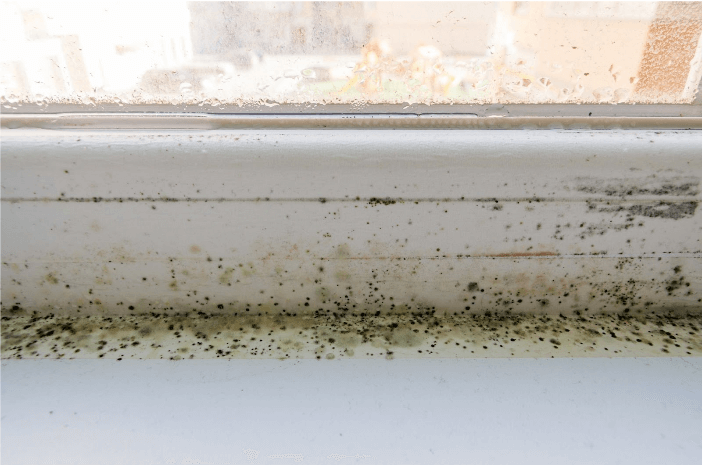
The mold itself looks dark green. Sometimes, when it becomes awful, it will turn into a “blackish” color. Mold reportings have had various colors, from purple to blue, from orange to pink. However, the most common colors for mold are dark green and black mold.
Now, because anything can be dark green or black, it is important to look at the mold infestation surroundings, such as walls and flooring. It is very common with mold present to see wallpaper peeling off and your drywall becoming “not so dry.” The ceiling can also become weakened from the mold, leaving parts of it at risk of falling. The reason for this is because mold eats away the material your house is used to be built. It rots away wood – hence the smell – leaving important pieces to the structure compromised and at risk of collapsing altogether. Wires and pipes can also be left exposed, creating additional hazards.
Another thing to keep in mind is if you can see the mold growth, the problem might be far more severe than it appears. Mold is not just present on the outside of your walls, but also on the inside, where you may have no clue what is going on. This is why it has been stated earlier that detecting and identifying mold can be more complicated than one may think.
 Site Title
Leave a comment